
Skin Concerns · July 26, 2026 · 6 min · By Yasmin Delacroix
What a Laser Test Spot Actually Proves, and What It Cannot
Almost every Beverly Hills laser consult offers a test spot, and almost nobody tells you how to read one. A 2025 survey of academic cosmetic dermatologists found the practice is not standardized at all, which means the reading protocol below is something you have to bring yourself.
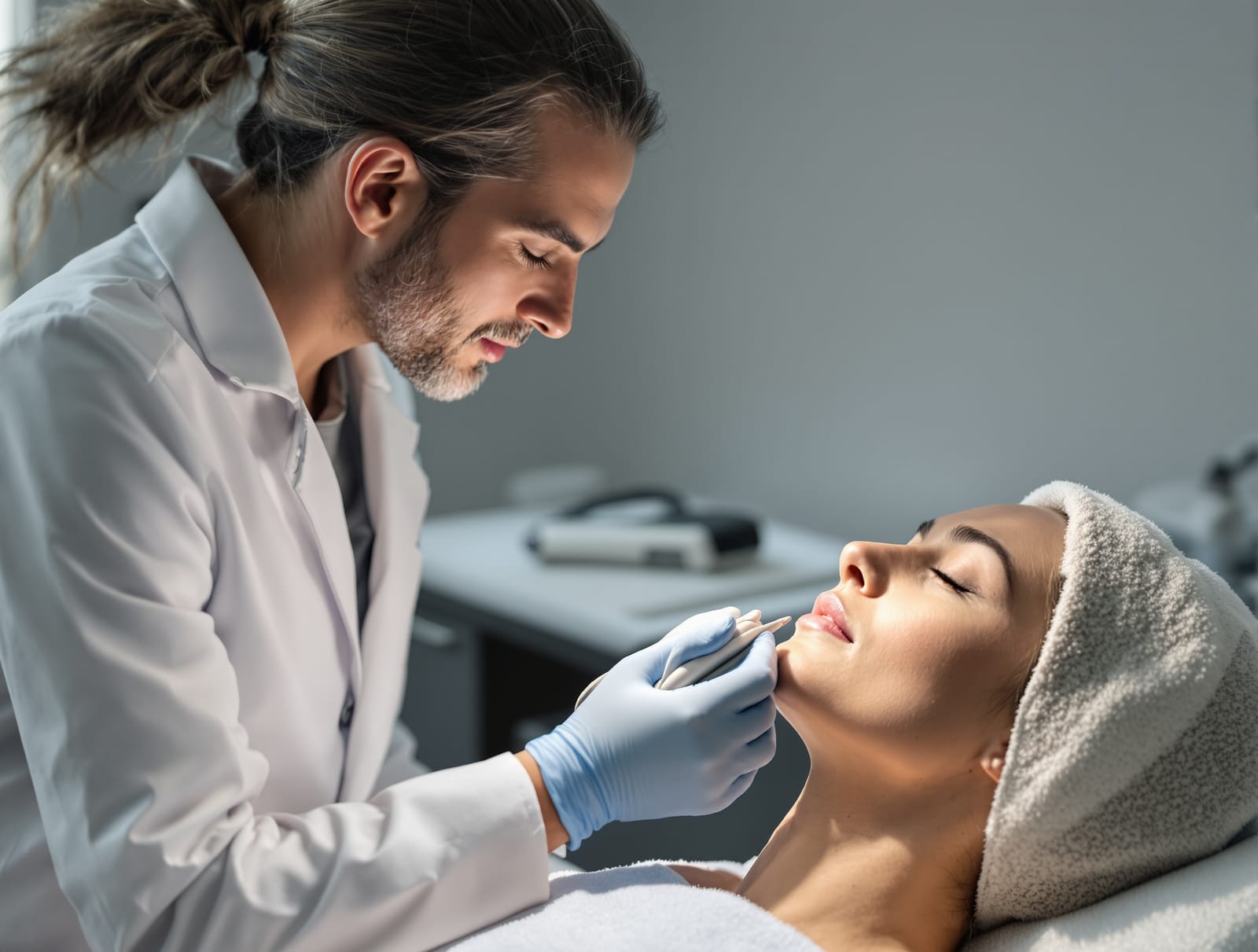
The offer comes near the end of the consult, usually after the pricing conversation and usually in a reassuring tone. We can do a test spot first. Somewhere behind the ear, or under the jaw, or on the inside of the upper arm. Come back in a couple of weeks and we will see how you did.
Patients almost always say yes, and almost nobody asks the two questions that decide whether the test spot is worth anything: what are we looking for, and when are we looking for it. Without answers to those, a test spot is a small burn on a hidden part of your body that nobody reads carefully. This piece is the reading protocol nobody hands you.
The original element here is a four timepoint reading sequence for a laser test spot, with what each observation window actually rules in or out. It is built from what laser injury and pigment response physiology are known to do on a clock, not from a published consensus, because as the next section explains, no published consensus exists.
Start with the uncomfortable finding. In March 2025, Archives of Dermatological Research published a cross-sectional survey of members of the Association of Academic Cosmetic Dermatology asking how they actually use laser test spots. The useful result was not a number. It was the spread. Practices varied on whether to test at all, where to test, what settings to test at, and how long to wait, and the variation tracked with practitioner factors rather than with any shared standard (Archives of Dermatological Research, 2025). There is no accepted definition of what a test spot passing looks like. That is not a scandal, it is just the state of the evidence, and it changes what you should do with the offer.
It means a test spot is not a safety certificate. It is a single data point that you and the clinician have to interpret together, and if neither of you has a reading protocol, it produces false confidence rather than information.
Timepoint one, ten minutes after the pulse. You are looking for the immediate tissue response, and it is the only observation the clinician makes for you in the room. For pigment lasers, the expected response is a transient frosting or graying that fades. For vascular devices, transient purpura or a darkening of the vessel. For hair removal, perifollicular edema, which is a small raised ring around each hair opening, plus a smell of singed hair. What you want to notice is not whether something happened but whether it happened evenly. A patchy response across a two centimeter test area means the energy is not landing uniformly, which on a full face is how you get striping. Ask the clinician to look at evenness specifically, out loud, and to write down the settings.
The immediate response also has a failure mode worth naming. Grayish white blanching that does not fade within a few minutes, especially if it comes with pinpoint bleeding or immediate blistering, is an overtreatment signal at that setting, not a normal endpoint. That is the one result that should end the session rather than start it.
Timepoint two, twenty four hours. This window is about the inflammatory response, and it is where you learn about your own reactivity rather than about the device. Mild erythema and mild swelling are expected and mean very little. What matters is the ratio between what you were told to expect and what you got. A patient told to expect a day of pinkness who wakes up with a firm, hot, sharply demarcated square has a reactivity that will scale badly across a full treatment area.
Twenty four hours is also when you evaluate the aftercare instructions you were given, which are more predictive of your outcome than most people realize. A 2023 European expert recommendation set on supportive skin care around procedures is unusually specific about the role of barrier repair and photoprotection in the days after energy-based treatment (JEADV, 2023). If your test spot came with no aftercare guidance at all, you have learned something about the practice, which is arguably the more valuable finding.
Timepoint three, seventy two hours. Crusting, if any, should be forming and stable rather than spreading. A crust wider than the treated field, weeping, or increasing pain at day three is the presentation that needs a phone call rather than a wait. This is the window where a true burn separates itself from an expected treatment reaction, and it is the single most commonly missed checkpoint because patients assume the first day is the risky one. It is not. Read more on what that separation looks like in how to prevent burns from laser.
Timepoint four, four weeks. This is the only timepoint that answers the question most patients actually care about, and it is the one most test spots never reach because the follow up was booked at two weeks. Post inflammatory hyperpigmentation, the darkening that follows cutaneous inflammation, does not declare itself on a three day schedule. It typically becomes visible over weeks, and in richly pigmented skin it can continue to deepen before it fades (Journal of Drugs in Dermatology, 2022). A test spot read at fourteen days and pronounced clear has skipped the complication it was ostensibly designed to detect.
If you take one thing from this piece, take that. A two week test spot answers a different question than the one you asked. Book the reading at four weeks, or accept that you tested for burns and not for pigment. This matters most for the patients for whom test spots are most often recommended, which is covered in laser treatment on darker skin tones, and it is the reason post inflammatory hyperpigmentation after laser is the complication worth planning around rather than reacting to.
What the studies do not tell you. There is no published trial establishing that test spotting reduces complication rates in cosmetic laser practice. Not a negative trial, an absent one. The rationale is mechanistic and it is a reasonable rationale, but a clinician who describes a test spot as proven is overstating the literature, and one who declines to test because there is no evidence for it is understating the asymmetry of the downside. Both positions are common in Beverly Hills consult rooms and neither is quite honest about the gap.
The practical consequence is that the test spot is only as good as the reading. Ask for the settings in writing, ask for a photograph of the site at the time of treatment with consistent lighting, take your own at twenty four hours, seventy two hours and four weeks in the same light and at the same distance, and book the follow up at four weeks rather than two. That sequence costs you nothing and converts a gesture into a measurement.
And bring the settings to your treatment consult. A test spot whose parameters were never recorded cannot inform the treatment it was meant to inform, which is a surprisingly frequent outcome and one worth adding to the questions to ask at a laser consultation.