
What to Know · July 1, 2026 · 6 min · By Ezra Caulfield
The Carbon Laser Peel (Hollywood Facial): What It Actually Does
Marketed across Beverly Hills as a lunchtime glow with zero downtime, the carbon laser peel is a real procedure with real physics behind it. Here is what the carbon layer does, what the laser targets, and where the marketing outruns the evidence.
Few treatments have a better name for a Beverly Hills menu than the carbon laser peel, often sold as the Hollywood facial, the carbon facial, or the black doll peel. The pitch is seductive: a black mask, a few passes of laser light, an instant glow, and no recovery. The name promises red carpet skin, and the price usually sits below most resurfacing procedures. But behind the branding is a specific and fairly modest physical process, and understanding it is the difference between realistic satisfaction and paying a premium for a very good exfoliation.
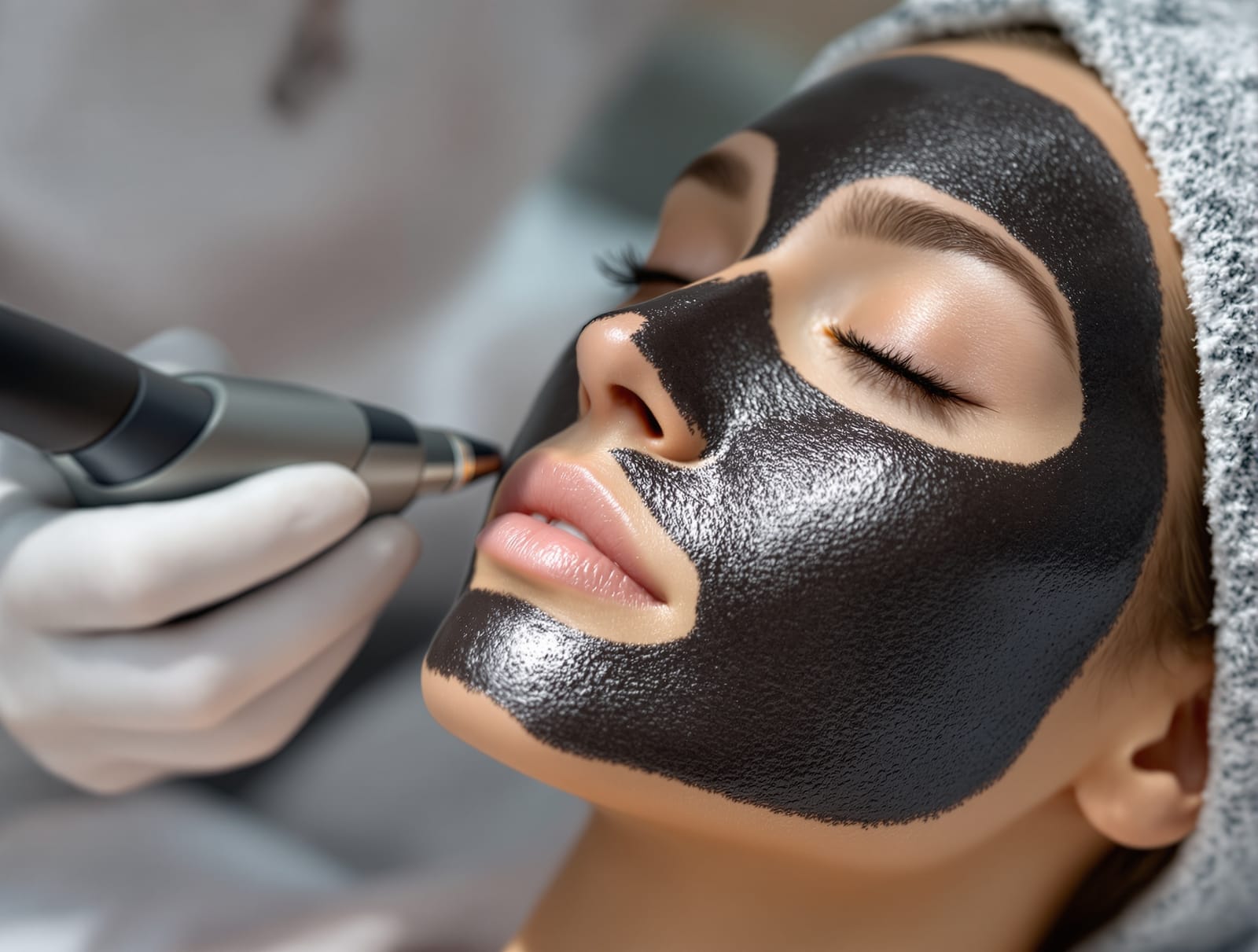
What actually happens on the table. The treatment has two steps. First, a thin layer of medical-grade liquid carbon is spread over the skin and allowed to dry. Carbon particles settle into pores and bind to surface oil, dead skin, and debris. Second, a Q-switched Nd:YAG laser, the same class of device used for tattoo and pigment removal, is passed over the face. The carbon acts as an artificial chromophore, meaning it is a target that strongly absorbs the laser's energy. The laser fires in extremely short pulses, and the carbon particles heat and shatter almost instantly, taking the bound debris with them in a photoacoustic snap. That is the peel: the carbon is blown off the surface along with whatever it grabbed.
Two modes, two effects. Most protocols use the laser in two ways during a single session. A higher-energy pass ablates the carbon layer for exfoliation and pore clearing. A second, lower-energy pass without heavy carbon coverage delivers gentle heat into the upper dermis. This is a form of laser toning, and it is mechanistically related to non-ablative rejuvenation. The mild thermal signal can nudge fibroblasts toward modest collagen activity over time, which is where claims of tightening and glow originate. The honest framing is that this is a light, cumulative effect, closer to what you would expect from a device like Laser Genesis than from fractional resurfacing.
What the evidence supports. The strongest, most consistent benefit is superficial. Patients reliably report smoother texture, a temporary reduction in surface oiliness, and a brighter, more refined look immediately after treatment, largely because the outermost layer of dead cells and sebum has been cleared. The American Academy of Dermatology notes that superficial procedures aimed at exfoliation and oil control produce short-lived cosmetic improvement rather than structural change, and the carbon peel fits squarely in that category. For patients with congested, oily, or dull skin and enlarged-looking pores, a series can make the skin appear temporarily clearer. Whether it truly shrinks pores is a separate question, and the answer is closer to no than yes, as covered in our look at whether lasers can shrink large pores.
Where the marketing outruns the biology. The carbon peel is frequently sold as an acne cure, a scar treatment, and a wrinkle eraser. It is none of those. Active acne may look calmer after a session because of oil clearance and a mild antibacterial thermal effect, but the peer-reviewed literature does not establish it as a standalone acne therapy, and it does nothing meaningful for atrophic acne scars, which are a dermal architecture problem requiring fractional energy or microneedling. It will not remove established wrinkles or lift lax skin. Anyone promising those outcomes from a lunchtime carbon session is selling the name, not the mechanism.
The safety picture, and why skin tone matters. Because the laser is tuned to carbon rather than to your own pigment, the carbon peel is often described as safe for all skin types. That is mostly, but not entirely, true. The 1064 nm Nd:YAG wavelength is weakly absorbed by melanin, which is exactly why it is the workhorse for treating darker skin safely. The risk is not the laser targeting your melanin directly, it is uneven carbon application. If the carbon layer is patchy or too thin in spots, the laser can deposit energy into the skin itself, and in Fitzpatrick types IV to VI that can trigger post-inflammatory hyperpigmentation or, rarely, small burns. According to guidance echoed by the Mayo Clinic on laser-based procedures, operator technique and appropriate device settings are the primary determinants of safety. The takeaway is practical: the machine is forgiving, the technician is not optional.
Downtime and expectations. This is one of the genuinely low-downtime treatments. Most patients have mild redness and a warm sensation for a few hours, and makeup is usually fine the next day. Results are immediate but transient, typically lasting one to three weeks, which is why practices sell it in packages of four to six sessions and recommend maintenance. The FDA clears Q-switched Nd:YAG lasers for a range of dermatologic uses, and the carbon peel is an off-label application of an approved device, which is common and legitimate in aesthetic medicine but worth knowing.
Is it worth it? For the right person and the right expectation, yes. If you have oily, congested, dull skin and you want a reliable, comfortable brightening treatment before an event, the carbon peel delivers exactly that. If you are chasing scar correction, wrinkle reduction, or permanent pore change, your money is better spent on a treatment matched to that biology. As always in a market this saturated, the most useful signal is a provider who explains the mechanism in plain terms and tells you what the treatment cannot do.
Related reading: What Is Laser Genesis and What It Does for Tone and Texture.
Further reading: Efficacy of Carbon Peel Laser in Acne Vulgaris in Skin of Color: A Single Center Prospective Study (J Cutan Aesthet Surg 2023); Carbon Peel Laser Technique to Improve Skin Quality: Back to Science! (Dermatol Pract Concept 2020); Carbon Peeling Laser Treatment to Improve Skin Texture, Pores and Acne Lesions: A Retrospective Study (Medicina (Kaunas) 2022).
More in Explainer
View all →- Melasma and Lasers: Why Lower Energy Usually Wins
- Fractional CO2 vs Non-Ablative 1550 and 1927 nm: How to Actually Choose a Resurfacing Laser
- 1550 nm or 1927 nm? What the Two Workhorse Fractional Wavelengths Actually Do to Your Skin
- Ablative vs. Non-Ablative Fractional Resurfacing: What the Wavelength Actually Decides