
Laser News · April 13, 2026 · 5 min · By Ezra Caulfield
What Picosecond Laser Technology Actually Does
How picosecond lasers shatter ink and pigment faster than older systems, and what to expect from treatment.
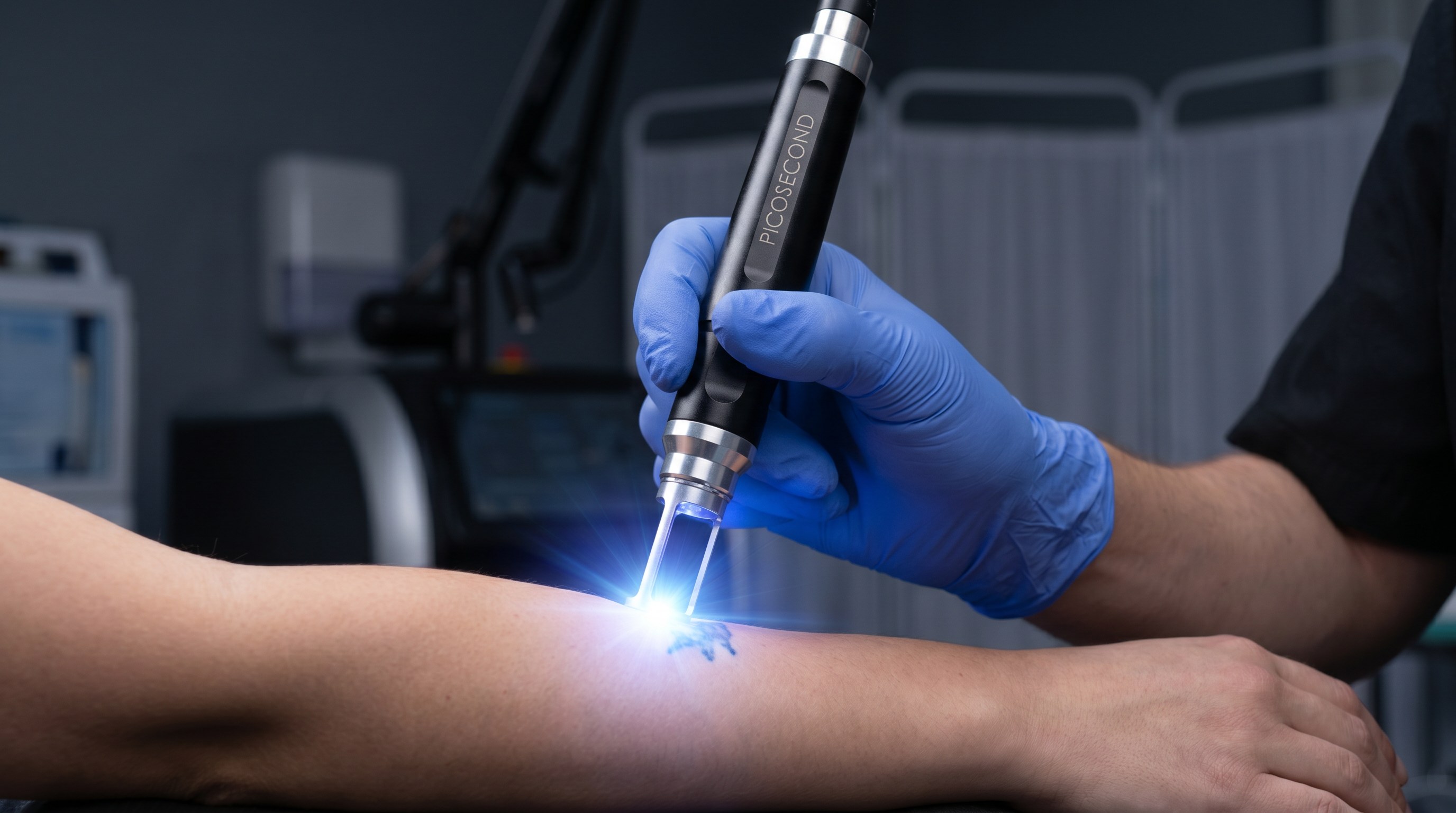
What is picosecond laser technology, and why has it become a benchmark in cosmetic dermatology over the past decade? The answer lies in the unit of time itself. A picosecond is one trillionth of a second, and lasers operating at this speed deliver energy to skin in extraordinarily brief pulses, fundamentally changing how the skin responds to treatment.
Traditional nanosecond lasers, which have been used for tattoo removal and pigmentation treatment since the 1990s, emit pulses lasting billionths of a second. Picosecond technology compresses that duration by a factor of one thousand. This dramatic reduction in pulse width changes the mechanism of action from primarily thermal (heat-based) to primarily photomechanical (pressure-wave-based). For an independent overview, see Lasers and lights: how dermatologists use them.
When a picosecond laser fires at targeted pigment, the ultra-brief pulse creates an acoustic shockwave that shatters ink particles and melanin deposits into smaller fragments. Because the pulse ends so quickly, less surrounding tissue experiences thermal damage. The body's lymphatic system can then clear away these smaller particles more efficiently than it could with the larger fragments left behind by nanosecond lasers. This is the core advantage: faster clearance, fewer treatment sessions, and potentially less collateral damage.
Picosecond systems work on tattoo removal, melasma, post-inflammatory hyperpigmentation, age spots, and certain benign pigmented lesions. Different wavelengths target different colors. The 532-nanometer frequency addresses reds and oranges, 755-nanometer handles greens and blues, 1064-nanometer reaches blacks and dark blues, and some platforms include a 1320-nanometer option for deeper pigmentation. Multi-wavelength or adjustable platforms allow clinicians to customize treatment to specific ink colors or skin conditions.
Candidacy depends on skin tone and the specific condition being treated. Picosecond systems with Nd:YAG wavelengths (1064-nanometer and longer) are safer for darker skin tones because they penetrate deeper and are less likely to cause post-inflammatory hyperpigmentation, a common risk when treating melanin-rich skin with shorter wavelengths. That said, any pigment-targeting laser carries some risk in skin types III through VI, and informed consent and patch testing are standard practice. Lighter skin types typically have fewer restrictions and faster healing.
Recovery depends on the specific treatment. For tattoo removal, most patients experience immediate redness and mild swelling that subsides within hours to days. Petechiae, tiny purple-red dots indicating bleeding beneath the skin, sometimes appear and fade within one to two weeks. For melasma or age spots, erythema and slight crusting may occur, typically resolving in three to seven days. Patients are advised to avoid sun exposure, use broad-spectrum sunscreen, and follow post-care instructions to prevent complications. For related context, see our note on Laser vs Chemical Peel for Sun Damage: Mechanism, Recovery, and Results.
Treatment spacing differs between conditions and individual healing patterns. Tattoo removal typically requires sessions spaced six to eight weeks apart, allowing lymphatic clearance between sessions. Melasma or pigmentation may respond to monthly or bimonthly treatments. Most patients see visible improvement within two to four sessions, though complete clearance varies widely based on ink depth, pigment burden, and skin response.
Results are realistic but not instantaneous. Picosecond lasers accelerate pigment breakdown compared to nanosecond devices, but they do not eliminate ink in a single session for most tattoos. Black and blue inks typically respond best; pastel colors, metallics, and certain professional inks are more resistant. Similarly, melasma often requires multiple sessions and may recur without strict sun protection, since ultraviolet exposure triggers new pigment production.
Cost varies by geography and treatment scope. Picosecond tattoo removal sessions typically range from 150 to 500 dollars per session, depending on tattoo size. Full-face melasma or pigmentation treatments may cost 300 to 800 dollars per session. Comprehensive tattoo removal requiring a series of sessions can total 1,500 to 5,000 dollars or more. Insurance rarely covers cosmetic laser treatment, though some sessions for treating post-inflammatory hyperpigmentation or certain skin conditions may qualify for partial coverage depending on medical necessity documentation.
The advantage of picosecond technology is real: faster photomechanical breakdown, fewer thermal side effects, and shorter overall treatment courses. However, it is not a magic solution. Results depend on pigment type, location, skin tone, and realistic expectations. Consulting a board-certified dermatologist or laser specialist remains essential to assess candidacy and predict outcomes.
Related reading: Is Laser Skin Resurfacing Worth It? What the Science Says, Does Laser Hair Removal Really Last Forever? A Clinical Reality Check.
More in Explainer
View all →- Melasma and Lasers: Why Lower Energy Usually Wins
- Fractional CO2 vs Non-Ablative 1550 and 1927 nm: How to Actually Choose a Resurfacing Laser
- 1550 nm or 1927 nm? What the Two Workhorse Fractional Wavelengths Actually Do to Your Skin
- Ablative vs. Non-Ablative Fractional Resurfacing: What the Wavelength Actually Decides