
Treatment Guide · April 2, 2026 · 5 min · By Soren Mackenzie
What Is New in Cosmetic Lasers This Year: New Laser Technology 2026
Advanced picosecond systems, hybrid platforms, and AI-guided targeting reshape cosmetic laser safety and efficacy in 2026.
New laser technology 2026 represents a meaningful shift in how dermatologists and cosmetic surgeons approach skin resurfacing, pigmentation removal, and tattoo clearance. Rather than incremental refinement, this year's devices introduce fundamental changes to pulse duration, wavelength stacking, and real-time feedback mechanisms that alter both clinical outcomes and safety profiles, particularly for patients with darker skin types.
The most clinically significant development involves picosecond laser systems becoming mainstream. Unlike nanosecond lasers, which deliver energy over billionths of a second, picosecond devices compress pulses into trillionths of a second. This matters mechanically: shorter pulses fragment chromophores (pigment particles) more efficiently with less heat diffusion into surrounding tissue. For tattoo removal, this means fewer sessions to achieve clearance, typically 6 to 10 treatments instead of 12 to 20, depending on ink type and depth. For age spots and melasma, picosecond technology reduces the risk of post-inflammatory hyperpigmentation, a critical safety consideration for patients with skin types III to VI. For an independent overview, see Lasers and lights: how dermatologists use them.
Mechanistically, picosecond energy generates photoacoustic effects rather than relying primarily on photothermal (heat-based) removal. The rapid energy release creates pressure waves that shatter pigment without requiring the high temperatures that damage melanocytes in darker skin. Studies show that picosecond Nd:YAG wavelengths, which penetrate deeper into dermis while bypassing epidermal melanin, have reduced adverse pigmentation in Black and Hispanic patients compared to earlier nanosecond platforms.
A second major category emerging in 2026 involves hybrid and stacked-wavelength systems. Manufacturers are integrating multiple laser types into single platforms: 1064 nm Nd:YAG for deep vascular and pigmented lesions, 532 nm frequency-doubled Nd:YAG for superficial pigmentation, and 1927 nm thulium fiber lasers for fractional resurfacing. The clinical advantage is precision targeting without device switching. A patient treating both port-wine stain and solar lentigines can receive appropriate wavelengths in one session, reducing appointment time and overall treatment cost.
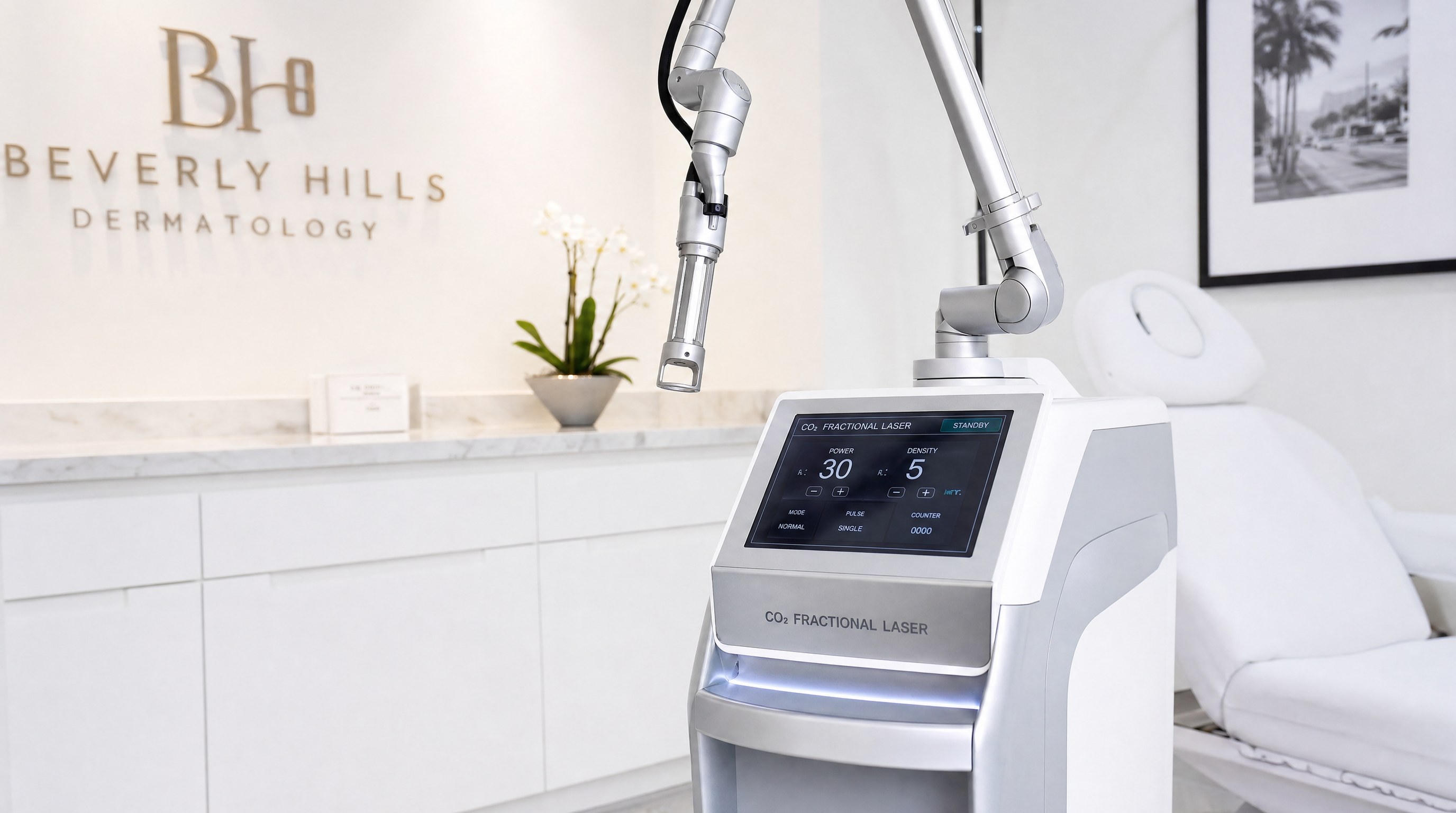
Thulium fiber lasers deserve specific attention. Operating at 1927 nm, they occupy a wavelength sweet spot: they absorb strongly in water (the skin's primary chromophore) but penetrate deeper than ablative CO2 lasers and with less collateral thermal damage. This makes them useful for fractional resurfacing with reduced downtime. Traditional fractional CO2 requires 5 to 7 days of obvious crusting and erythema; newer thulium systems reduce this to 2 to 3 days in many cases. Candidacy remains similar: patients seeking fine lines, acne scars, or texture improvement, though those with active herpes simplex or keloid history should be excluded. Recovery involves mild edema and erythema, with most patients resuming normal activities by day three to four. For related context, see our note on Laser vs Chemical Peel for Sun Damage: Mechanism, Recovery, and Results.
AI-guided targeting and real-time thermal feedback represent the third innovation wave. Newer platforms incorporate optical coherence tomography (OCT) and thermal cameras to map lesion depth and monitor skin temperature during treatment. This prevents operator-dependent variation and automatically reduces fluence if skin temperature approaches unsafe thresholds. For providers treating ethnically diverse populations, this real-time safety net is particularly valuable, as it compensates for natural variation in epidermal thickness and melanin density.
Cost structures for 2026 technology reflect increased sophistication. Picosecond tattoo removal runs 150 to 400 dollars per session, down from historical 200 to 500 dollars for nanosecond systems, driven by reduced session counts offsetting higher per-session device costs. Hybrid platform treatments for mixed vascular and pigmentary concerns typically cost 400 to 800 dollars per session. Fractional thulium resurfacing ranges from 1200 to 2500 dollars depending on treatment area and intensity.
Recovery profiles vary by indication. Pigment removal with picosecond systems shows minimal downtime: mild erythema for hours, possible temporary hypopigmentation in treated areas that typically resolves within weeks. Fractional resurfacing involves predictable wound healing: days one to three show crusting and swelling, days four to seven involve peeling, and full remodeling continues for 2 to 3 months as collagen reorganizes. Patients must avoid sun exposure and use strict photoprotection (SPF 50 or higher) throughout recovery, as new melanin synthesis is active.
Realistic expectations remain critical. Picosecond systems do not eliminate tattoos in one session; they require a series. Fractional resurfacing improves but does not erase deep acne scars. Vascular lesions may lighten by 50 to 80 percent but rarely vanish completely. The 2026 technology wave offers genuine clinical advantages in speed, safety, and precision, not transformation of fundamental laser physics.
Related reading: Does Laser Hair Removal Hurt? A Clinical Breakdown of Sensation and Pain Management, How Long Does IPL Redness Last: What to Expect After Treatment.