
Cost & Recovery · May 19, 2026 · 5 min · By Ezra Caulfield
What Laser Tattoo Removal Costs: A Clinical Overview
Understanding the factors, mechanisms, and realistic pricing behind professional laser tattoo removal treatment.
Laser tattoo removal cost varies widely depending on tattoo size, ink color, skin type, and geographic location, typically ranging from 200 to 10,000 dollars across multiple sessions. Before exploring pricing, it helps to understand how the technology actually works and what determines both clinical outcomes and final bills.
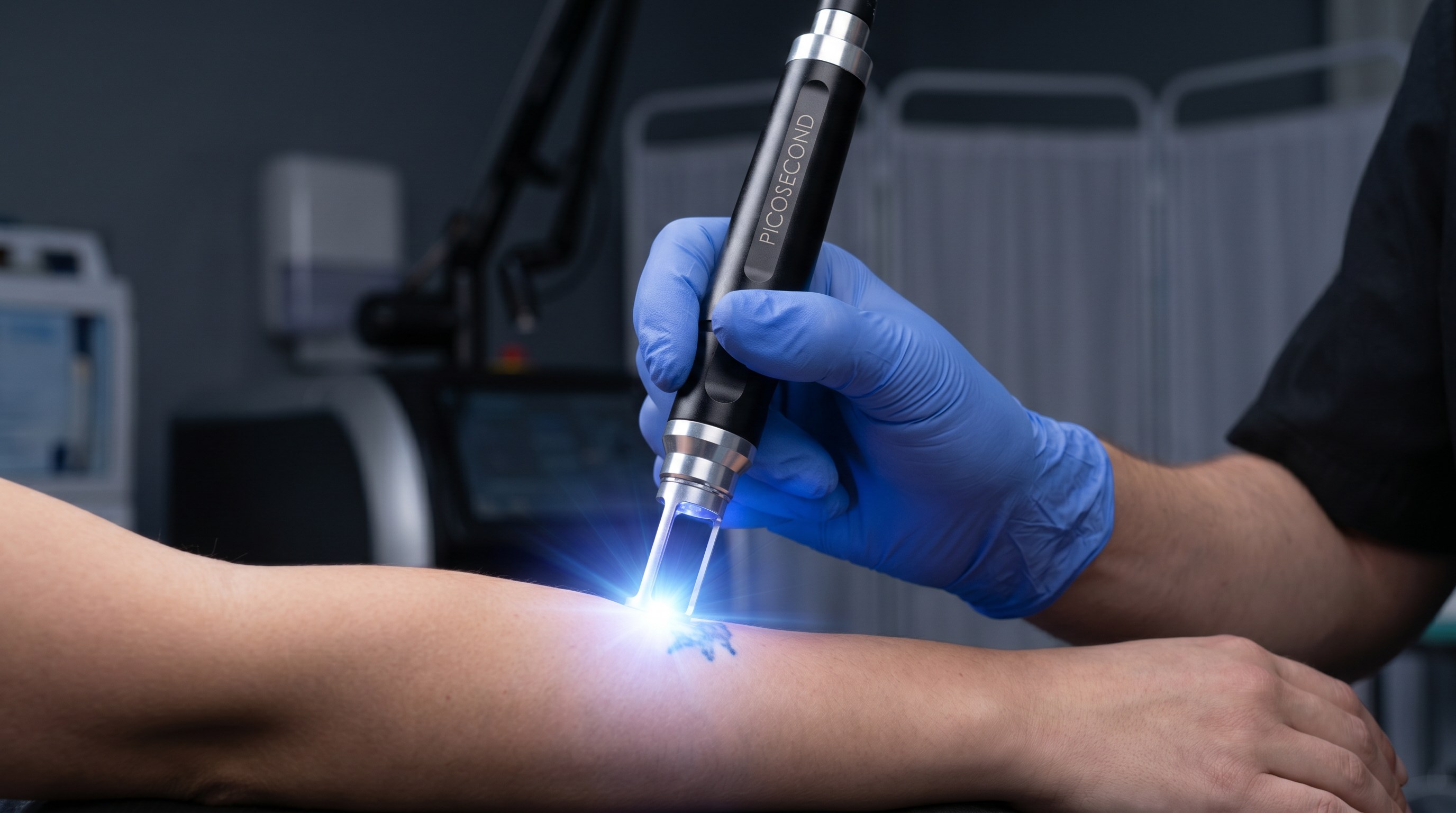
The most common laser platforms for tattoo removal operate on the principle of selective photothermolysis. These devices emit short pulses of light, usually in the nanosecond range, that pass through the skin and are absorbed by tattoo ink particles. The absorbed energy causes the ink to fragment into smaller particles, which the body's lymphatic and immune systems then gradually eliminate over weeks and months. Different wavelengths target different ink colors: Q-switched Nd:YAG lasers (typically 1064 nanometers) are effective on black, blue, and red inks, while alexandrite (755 nanometers) and ruby (694 nanometers) lasers excel at greens and other colors. Picosecond lasers, which pulse in trillionths of a second, fragment ink more efficiently than nanosecond devices, though they command higher per-session costs. For an independent overview, see Tattoo removal: how dermatologists approach it.
Not all patients are equally good candidates. Ideal candidates have fair to medium skin tones and dark tattoos. Those with darker skin types, particularly Fitzpatrick IV to VI, face a real clinical consideration: the risk of post-inflammatory hyperpigmentation or hypopigmentation where the tattoo was. Nd:YAG lasers remain the safer choice for darker skin because their longer wavelength penetrates deeper without concentrating energy in the epidermis. Practitioners treating darker skin typically use lower fluence (energy density) and longer intervals between sessions, which extends treatment timelines and can increase total cost.
Tattoo age, size, and complexity all influence pricing. Professional, single-color tattoos on the arm or leg typically cost less to remove than large, multicolor amateur or professional pieces. A small black tattoo measuring 1 to 2 inches might cost 100 to 300 dollars per session, while a full-sleeve tattoo could run 500 to 2,000 dollars per session. Most tattoos require 6 to 15 sessions spaced 6 to 8 weeks apart to allow the body time to clear fragmented ink. This means realistic total costs often range from 1,200 to 15,000 dollars or more for extensive work.
Geographic location and clinic overhead significantly affect pricing. Metropolitan areas and prestigious practices typically charge 300 to 800 dollars per session, while less densely populated regions may charge 150 to 400 dollars. The specific laser platform matters too. Picosecond devices cost practices more to purchase and maintain, so they generally command premium pricing, often 400 to 1,000 dollars per session compared to 200 to 600 dollars for older Q-switched systems. Newer doesn't always mean dramatically faster removal, however. While picosecond technology does offer marginal speed advantages, especially for stubborn colors, most darkly inked tattoos still require multiple sessions regardless of device type. For related context, see our note on Fraxel vs Moxi: Comparing Recovery Time.
Recovery is generally straightforward but not instantaneous. Immediately after treatment, patients experience redness, swelling, and sometimes blistering or scabbing similar to a thermal burn. Most visible effects resolve within 1 to 2 weeks. Patients must avoid sun exposure, keep the area clean and moisturized, and refrain from picking scabs. Rare but documented complications include permanent scarring, particularly in patients prone to hypertrophic scars or keloids, or infection if the area is not properly cared for. Actual ink removal happens gradually over the following weeks as the immune system processes fragmented particles. Complete clearance often takes 12 to 24 months of consistent treatment.
Results are rarely perfect. Many patients achieve 75 to 95 percent clearance, but some ink, especially certain greens and purples, remains stubbornly visible. Amateur tattoos with thin lines and less densely packed ink tend to clear more completely and faster. Professional tattoos with saturated color and layered technique are harder to eliminate entirely. Some patients stop treatment once the tattoo is faint enough to cover with new work or clothing, accepting incomplete removal rather than pursuing the additional cost and time of full clearance.
Before committing, patients should request a consultation with a provider who uses appropriate technology for their skin type. Total laser tattoo removal cost ultimately reflects the complexity of the ink, the patient's skin characteristics, the technology used, and the number of sessions required to reach the desired endpoint. Understanding these variables helps set realistic expectations for both timeline and expense.
Related reading: Halo Laser vs Fraxel, Compared, Laser for Broken Capillaries on the Nose: A Clinical Treatment Guide.